Thomas Napierkowski recently published an article on my book LIGHTNING AND ASHES in the journal POLISH AMERICAN STUDIES, and I thought I would share the link.
Here's a paragraph from Prof. Napierkowski's study:
Like all good poets, John Guzlowski writes poems that have universal relevance; his poems, for example, deal with parent-child relations, husband-wife bonds, new beginnings, death (especially the death of parents), family connections (and disconnections), tragedy, trauma, and endurance. In the case of Guzlowski, however, these universal themes are anchored in Polish and Polish American experiences and also importantly in a segment of the Polish American community which has, until recently, been virtually voiceless—without, at least, a strong and clear literary voice. As a talented poet and a powerful voice for Polonia, John Guzlowski deserves our attention, our thanks—and our support.
Wednesday, September 3, 2008


Wednesday, August 20, 2008
Polish American Studies Online
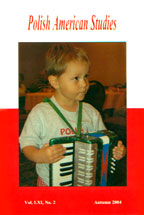
Dear Friends, I recently received a note from Anne Kirchmann, the President of the Polish American Historical Association. She informed me that the journal Polish American Studies was now online. It is available through the History Cooperative at:
http://www.historycooperative.org/
This journal has published articles on every aspect of Polish American life. There have been articles about Polish-American artists, parishes, workers, literature, history, music, and so much more. (The current issue contains a review of my book Lightning and Ashes, about my parents and their experiences in the concentration camps in Germany.)
Here's a description of the the journal:
Polish American Studies is an interdisciplinary, refereed scholarly
journal, published twice each year. It is a member of the History
Cooperative and JSTOR electronic databases and is abstracted in
Historical Abstracts, America: History and Life, and The Catholic
Periodical and Literature Index.
The editors welcome scholarship including articles, edited documents, bibliographies and related materials dealing with all aspects of the history and culture of Poles in the Western Hemisphere. They particularly welcome contributions that place the Polish experience in historical and comparative perspective by examining its relationship to other ethnic experiences.
Contributions from any discipline in the humanities and social sciences are welcome.
Recent acceptance rates for unsolicited manuscripts were: 28.6% in 2007, 47.2% in 2006 and 36.4% in 2005. Inquiries and submissions may be sentto the editor, James S. Pula, at jpula@pnc.edu .
Thursday, August 14, 2008
POEMS AND PHOTOS OF POLAND

Recently, poems by Phil Boiarski, Katarzyna Borun-Jagodzinska, Elisabeth Murawski, and Christina Pacosz have appeared in an issue of the photography journal Private devoted to Poland and the vision of Polish photographers. The poems and the photos are stark, whimsical, touching, shocking, and inspiring.
A preview of the journal is available online.
Here are some of the poems:
How We Learned About the War
Elisabeth Murawski
There were the pictures from Life,
the spider in the brain of Harry Truman
saving the boys time by dropping the bomb.
There were the silent films of opened
boxcars in Poland, the sticks and stones
with holes for eyes that went on living.
Parts of V-mail letters arrived, sometimes
after the telegrams lame with regret.
In the windows hung miniature flags,
their stars assigned a simple code
of blue, silver or gold. Gold
was for the unlucky. Only months,
years later would diaries come to light
so that we might hear the boots
that kept the Jews awake, see shadows
burned into a wall. Only then
would we see how the world always knows
what it is doing--girding for war
and whistling, while Lorca died and Picasso
on fire created the hips of Guernica.
Sometimes we forget the noose and its length--
how we are joined. We hang our souls
in windows prophets die for, playing
our parts at both ends, holding
our spotted coats in our hands.
(first published in The Literary Review, USA)
Wawel
Phil Boiarski
Five thousand decades have passed
since the dragon with a taste for virgins
was slain by Prince Krak. The jewels
of royalty and the chambers of the rich
rise above the cave where the bones
mounded before the open wound
in the earth. The stench of rotting
flesh and the fiery belches of
the beast, led the brave knight
deep within the bowels of
the hill, to slay the evil thing.
And while the mass is said
and the choir sings, the beast
awaits within. Where once
again it will awaken.
At Morskie Oko Lake, Zakopane
Christina Pacosz
It is a gray country
even when the sky is blue
and today it is raining.
Mist gathers itself
a quiet fist
clutching the mountains.
Nuns in gray habits
walk over gray rocks
circling the lake.
If this is too much gray
look at the trees, green
bodies, beds of moss
waiting, the small blue
eyes of niezapominakji*
watching.
The nuns have disappeared
and only the shore of the lake
the eye of the sea
is visible, a narrow
border of aquamarine
filled with trout flicking
tails in cold water
swimming in the only
sky there is.
* forget-me-nots
( Christina's book, This Is Not a Place to Sing, West End, 1987)
A Patriotic Song (1981)
Katarzyna Boruń-Jagodzińska
Maybe it was a dream,
maybe it didn’t exist,
though everyone remembers
how this country
lived and suffered and loved.
It was sung in the margins of letters,
in hundreds of poems.
From the very beginning
it was branded with ash.
Poland —
a word wilted
by familial warmth:
mother and father
waiting at the table
to break the Christmas wafer
with the son who never returned
from the war,
the daughter who loves carousing,
and beloved cousin who cleans houses
in a foreign land.
The heirloom rosebush,
packed carefully in straw,
rots from excessive warmth,
though with each passing year,
the winters here grow longer.
(translated in English by Karen Kovacik)
Monday, August 11, 2008
John Guzlowski: Editor's Choice for KRITYA
Poet and Editor Rati Saxena has chosen some of my poems about my mother for the "Editor's Choice" feature of KRITYA, an online Journal of Poetry.
 The selection of poems includes several from my book Lightning and Ashes as well as some recent poems written since my mother's death. The poems are available in Hindi as well as English.
Here's one of the poems Rati Saxena chose:
WHAT THE WAR TAUGHT HER
My mother learned that sex is bad,
Men are worthless, it is always cold
And there is never enough to eat.
She learned that if you are stupid
With your hands you will not survive
The winter even if you survive the fall.
She learned that only the young survive
The camps. The old are left in piles
Like worthless paper, and babies
Are scarce like chickens and bread.
She learned that the world is a broken place
Where no birds sing, and even angels
Cannot bear the sorrows God gives them.
She learned that you don't pray
Your enemies will not torment you.
You only pray that they will not kill you.
--
Lightning and Ashes is also available from the publisher, Steel Toe Books.
Monday, August 4, 2008
TEN SONGS FROM BULGARIA: UPDATE

After posting the earlier piece on Linda Nemec Foster's "Ten Songs From Bulgaria," I asked her to tell me something about the inspiration for this new book.
Here's what she wrote:
Ten Songs from Bulgaria is my latest chapbook (my eighth poetry collection) and it was recently published by Cervena Barva Press in Massachusetts. It was a top finalist in the Press' national chapbook competition and, although it did not win, the editor accepted the manuscript for publication. The poems were inspired by the black and white photographs of Bulgarian artist, Jacko Vassilev.
Several years ago, Harper's Magazine featured a portfolio of his work and I was very moved by his haunting portraits of the people that inhabit the fringes of Eastern European society: the inmates of mental institutions, the very poor, the homeless veterans, the destitute and abandoned, the itinerant musician and his performing bear trying to smile for the camera. I knew I had to write poems in response to Vassilev's work.
With my Polish and Slavic heritage, I have always been fascinated by the "other Europe"---not the traditional tourist traps of Britain, France, Italy, or Germany (they certainly have their allure)---but the landscape of central and eastern Europe that only recently has been released from history's dark shadow. In some places, that shadow still persists and Vassilev's photographs reflect the people living there with their joys, sorrows, exurberance, and pain. I hope my poems in some way recognize their lives and honor their spirits. As poet and writer living in America, I was overwhelmed by these images from the other side of the world.
__
Linda's Ten Songs from Bulgaria is available from Cervena Barva Press.
Vassilev's photos are available for viewing online at his website.
You can find out more about Linda Nemec Foster at her website.
Wednesday, July 30, 2008
TEN SONGS FROM BULGARIA by Linda Nemec Foster

When I read and reviewed Linda Nemec Foster's Amber Necklace from Gdansk several years ago for the Sarmatian Review, I knew that I was reading an essential Polish-American poet.
This sense has only increased as I've read more and more of her poetry over the years.
I'm looking forward, therefore, to her recently announced chapbook from Cervena Barva Press, Ten Songs from Bulgaria.
Here's one of the poems from the book:
TWO VLADIMIRS AT THE WINDOW
Small lives, small lives,
we are trapped inside
small lives. Call this window
a prison of rotten wood; the hinges
a broken lock that still won’t release us.
Call us the curse of clouded mirrors,
the blank faces of the soul
stuck inside an old kaleidoscope.
Small lives, small lives. We hum and chant
to the silence outside the frame.
__
Here's what Faye Kicknosway, one of the book's early readers, said about it:
These poems evoke--in their concision and clarity--intense, disturbing images of lives shredded into pieces so small all that’s left is the memory of having endured. They are caged inside the empty space of the page, which seems to want to suffocate their spare, fragile, incredible beauty. Each image speaks a world that is window and mirror of what we hide from in the fabricated assemblages we make against the truth these poems speak.
-
The book is available from The Lost Book Shelf.
Thursday, July 24, 2008
CHRISTINA PACOSZ: LETTERS TO THE WORLD
Polish-American poet Christina Pacosz has recently been featured in the Red Hen anthology Letters to the World: Poems from the Wom-Po Listserv.
Here's one of Christina's poems from the anthology, followed by a part of what reviewer Laurel Johnson said of her contribution to this collection of poems:
CHRISTINA'S POEM
SUMMER IS FRAYING
Squirrel nests are falling down
Fourth of July has been here and gone
Summer is waning
Though swallows still chortle as they dance through the air
And robins strut on stunted lawns
The drought drags on
Squirrels pair off
On the back porch rail
To groom each other
Before their rut
It is the season
Though summer is fraying
My thoughts stray to her, to him
Each of those four gone
The family pentacle broken now
Leaving me alone
On the lone prairie
Too exhausted to howl at the moon
And the war drags on
The bloody war drags on
And spreads
Around the world
Like an awful fleet of ships
A terrible wind filling their sails
THE REVIEW
Several years ago I reviewed the collected poetry of Christina Pacosz. Her beautiful words stunned me to silence and I've been following her published poetry online ever since. Like many female poets from around the world, Pacosz is a member of the Wom-Po Listserv -- an internet presence founded by Annie Finch and recognized internationally for its excellence. Wom-Po's goal as a website and the purpose of this anthology is to "give women poets and their poetry the recognition they deserve." To date, Wom-Po spin offs include listservs, workshops, collaborations, translations, and networking opportunities unavailable to female poets of earlier generations.
This is an exceptional anthology, one to be savored slowly by poetry lovers everywhere. With a universal wisdom, tenderness and grace, these poets transcend the violence we see every day in the world around us. They are the Emily Dickinsons of their time, sending their messages to the world. To quote the Dickinson poem:
This is my letter to the world,
That never wrote to me…..
In this age of wars and cultural divisions, it's time the world listens and writes back in kind. That's what the Wom-Po listserv poets hope to accomplish with this anthology. Highly recommended.
-----
This anthology is available from Red Hen Press and from Amazon.
Subscribe to:
Posts (Atom)