Showing posts with label Adam Zagajewski. Show all posts

Thursday, March 28, 2013

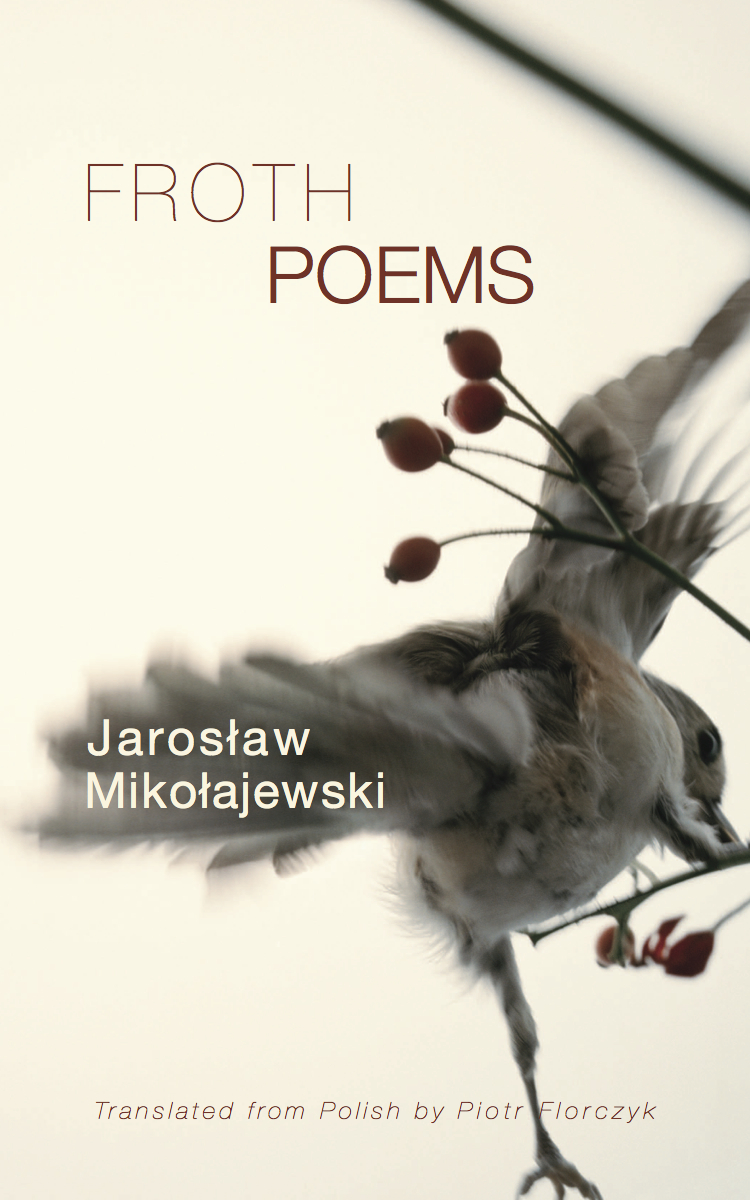
Jarosław Mikołajewski’s Froth: Poems


Piotr Florczyk continues his excellent work bringing Polish poets to an American audience.  His most recent work is a translation of a group of Jarosław Mikołajewski’s best poems.  The collection is called  Froth: Poems (Calypso Editions, 2013), and these poems mix what one critic has called “family theater” with a surrealistic sensitivity that creates a kind of domestic magic that draws you in and makes you want to keep reading and seeing the world through  Mikołajewski’s always engaging and often funny lens.

Mikołajewski, a short story writer, poet and translator, has received tremendous praise.  Ilya Kaminsky calls his poems "contemporary European poetry at its best," and Adam Zagajewski writes, "Mikołajewski's poems are kicking, running, appealing to us, readers. His poems live."

Here are three of the poems from this collection, first in Polish and then in Piotr Florczyk's English.

Kręgosłup mojej żony

W porze oczekiwania
kręgosłup mojej żony jest gałęzią
pękającą od nadmiaru jabłek

pokorną aż do ziemi
z braku odporności

W noce czuwania
jej kręgosłup jest szalikiem
zaciśniętym na wychudłej szyi

W noce miłości zwierzęcej
Jest suwakiem walizki
która nie chce się dopiąć nawet pod kolanem

W noce miłości ludzkiej
jest stalową liną
szeleszczącą na wietrze pod najwyższym napięciem

Na południowym spacerze
kręgosłup mojej żony jest chorągiewką
przewodnika pielgrzymów w przeludnionym kościele

Na wieczór po dniu marszu
jest grupką wylęknionych dzieci
które zepsuły przedszkolne pianino
jest samą klawiaturą
zepsutego pianina

Pod wieczornym prysznicem
jej kręgosłup jest żmiją
w czujnym lenistwie na rozgrzanej drodze

Pod północną kołdrą
kręgosłup mojej żony jest jak drzazga płonąca w piecu
z którego rano wyjmę ciepły chleb


My wife's spine

And when my wife’s pregnant
her spine is a bough
breaking under the weight of apples

humble all the way down to earth
from lack of resistance

On nights of keeping watch
her spine is a scarf
tightened around a slender neck

On nights of animal love
it is the zipper in a suitcase
that won’t close, even under a knee

On nights of human love
it is the steel rope
rustling in the wind, at the highest voltage

On the noon walk
my wife’s spine is the flag
carried by the pilgrims’ guide in a crowded church

In the evening, after a day-long march,
her spine is a bunch of frightened kids
who broke the kindergarten’s piano
it is the keyboard
of the broken piano

When she takes a shower
her spine is a viper
lazing watchfully on a sizzling road

Under the midnight comforter
my wife’s spine is like a wood chip burning in the oven
from which I’ll pull out warm bread at dawn


Między ziemią a nie

ziemia głośno wyje
bo wszedłem na piętro
zejdź bo jestem głodna
skamle drapiąc drzwi

jej łakomy oddech
owiewa mi pięty
żona prosi żebym
uspokoił ją

zatrzaskuję okna
ziemia wyje głośniej
wychodzę na balkon
ona zgina łeb

rzucam jej owoce
woła nakarm sobą
i święcie przyrzeka
to ostatni głód

żeby mi pokazać
jak jest wychudzona
tarza się na grzbiecie
w kurzu swojej krwi

widzę góry żeber
hałdy suchej skóry
waruj wołam z góry
ona woła zejdź

zejdź a będę czuwać
zejdź a będę mruczeć
zejdź a będę ciepła
i miękka jak puch

nie schodź proszą dzieci
kiedy wkładam buty
ziemia warczy
żona
prosi coś z nią zrób


Between earth and not

the earth howls loudly
because I’ve gone upstairs
“come down, I’m hungry”
she yelps, scratching the door

her greedy breath
is fanning my heels
my wife asks me
to calm the earth down

I shut the windows
the earth howls even louder
I walk out onto the balcony
she lowers her gaze

I throw her fruit
she yells “feed me with yourself”
and swears to god
“this is my last hunger”

to show me
how emaciated she is
she rolls around on her back
in the dust of her blood

I see mountains of ribs
heaps of dry skin
“stay put” I call from upstairs
“come down” she says

“come down, I’ll be vigilant”
“come down, I’ll hum for you”
“come down, I’ll be warm
and soft like feathers”

“don’t do it,” the children plead
as I put on my shoes
the earth’s growling
my wife
pleads “do something about her”


unia europejska

za mało biorę do siebie

że wyszedłem w deszcz
miałem wrócić
ale wyszło słońce

pojechałem na cmentarz nieznany
położyłem rękę na grobie
powiedział wstań trupie

wstałem
poszedłem

za mało biorę do siebie
zmiany pogody
przejaśnienia

chciałem pójść w lewo
a siedzę na brudnie z ręką w grobie taty

mój łokieć tęcza nad europą


european union

I don’t take enough personally

that I went out in the rain
had to go back
but the sun came out

I went to visit an unknown cemetery
I put my hand on his grave
he said rise you corpse

I got up
I went

I don’t take enough personally
changes in the weather
clearings-up

I wanted to go to the left
but I’m sitting in the rough with my hand on my father’s
grave

my elbow a rainbow over europe

_______________________

More information about Froth: Poems and other books by Calypso Editions is available by clicking here

Writing the Polish Diaspora has also posted on Poitr Florczyk's translations of Anna Swir's Building the Barricades and other Poems and Julian Kornhauser's Been and Gone.  Clicking on these titles will take you to the articles.


Monday, October 11, 2010

ZAGAJEWSKI'S "ANTI-CRAFT LECTURE"


The following is an article written by the poet and journalist Oriana Ivy regarding a lecture that the Polish poet and Nobel Prize for Literature nominee Adam Zagajewski, author of Without End, Canvas and Tremors, recently delivered at the Vermont Studio Center. If you click on the link, you'll be taken directly to Ms. Ivy's site.

oriana-poetry: ZAGAJEWSKI'S "ANTI-CRAFT LECTURE" AT VSC, SEPTEMBE...: "                                                                                                       STEFAN GEORGE ADAM ZAGAJEWSKI’S “AN..."

Thursday, September 23, 2010

Been and Gone: Poems of Julian Kornhauser


Julian Kornhauser is a Polish poet, novelist, literary critic, and translator who, along with Adam Zagajewski, was one of the major figures of the New Wave poetry movement of the early 1970s. Although Kornhauser's work continues to be read and appreciated overseas (winnning the European Poetry Prize and the City of Krakow Prize), he's not very well known in this country.

This translation of his poems by Piotr Florczyk, therefore, is long overdue. Florczyk, a native of Krakow now teaching in the US, captures the stark clarity and mystery of Julian Kornhauser's Polish originals in this bilingual edition from Marick Press.

As poet Adam Zagajewski says of Kornhauser in his foreword to Been and Gone, "when I read Julian's poems now, I'm amazed by the continuity of his writing, by the honesty of his poetry, by his patient worship of the concreteness of the world. Poetry is for him like the origami he describes in the poem written while traveling from Karkow to Oswiecim, a small city whose German name was Auschwitz--an object both arbitrary and necessary:

We pass hills and forests,
a paper swan
looks sleepily on the burning
grass."

_________________

Here are two poems from Been and Gone I especially liked.

The first is dedicated to Ewa Kuryluk, an artist who left Poland in 1981 when martial law was imposed.

ETERNAL JOURNEY

A search, an escape, death.
The search for languages, the escape
from a school desk, death of dear ones.
Eternal journey over clouds of smoke,
a swirling thin thread of life,
game of lands, gruff farewells, naked bodies
impressed on the cloth. Heart calls out no more
for help, it sinks its claws into a glacier
hung high above the sky. The smell of burning
skin weakens a step from the abyss, the fire
of native captivity, unexpressed happiness.
Ever further, so not to return to the Viennese
apocalypse, young rebels, a departing
mother. Ever closer to a tiny bit of a table
and a narrow window, beyond which one
sees only the happy eyes of a a little Jewess
and two raised wings of an apple pie.


CHILDREN

are smarter than we are
know everything
even n o t h i n g to them has the hue of a chestnut
they see mountains where we don't see them
seas splash when nothing is heard
through their crooked teeth
words known to no one slip out
fear and an inexpressible adventure
lurk under dirty fingernails
when they run
their oversized shoes cackle
and their hair sticks to the wind
when they're silent
their eyes express so much adult longing
they stand on tiptoe
to touch what's forbidden
they try to wrestle with rules
to be able to tell the difference
between a joke and fear
sometimes they lie quietly on the floor
casting strange spells
and the the glass falls from the table
opportunity arises
a crayon moves slowly across the white-papered wall.

___________________________________

Some of Piotr Florczyk's own poem are available online. Here are two published in InPosse Review.

Monday, November 17, 2008

Polish Writers on Writing edited by Adam Zagajewski

Adam Zagajewski's Polish Writers on Writing, a fine collection of essays by various Twentieth-Century Polish writers including Milosz, Herbert, Szymborska, Schulz, and Zagajewski himself was reviewed by poet Ron Slate at his website On the Seawall .

Here's Ron's review.


Many of the writers in this excellent selection, writes Adam Zagajewski, "faced a choice not very different from the one their nineteenth-century predecessors were confronted with: namely, should the new catastrophe be understood and dealt with as a national disaster, or should it be approached as a global event provoking an answer couched in universal terms?" He then goes further: "So here's the innocent paradox of this generation. These brilliant writers understood that in bad times they should keep their inner freedom, their individual voices, and their passion for infinity and not bend under the nationalistic yoke. Yet the weight of the Polish nineteenth-century model was such that they needed a constant consultation, a constant conversation to withstand that pressure." Both at the heart of the empire and the among the conquered territories, the position of the writer is identical. The relevance of Polish writers --Wat, Herling, Szymborska, Baranczak, Gombrowicz, Schulz, Witkiewicz -- to American writers is manifest. As an admirer of Zagajewski's poetry and prose, I read this book as well to see his designations as the seminal statements of his literary compatriots.

Milosz is represented here by his poem "Ars Poetica?" and three essays. In "The Sand in the Hourglass," he writes, "Social reality is distinguished by the fact that it is opaque, treacherous, that with its myriad guises it deludes everyone who is entangled in it." We begin by thinking of the Polish writers as making stark choices between solitude and garrulousness, a matter of timing, of hiding and exposure. But going further, we find writers who illuminate the complexities and ambiguities of our feelings of modernity, writers who have absorbed philosophy and culture in a broad, worldly fashion. Zagajewski himself, in his essay "Beginning to Remember" in Ardor, described this temperament and perspective: "A strong poetic talent produces two contradictory phenomena. It suggests, on the one hand, intense participation in the life of your age, plunging into it up to your neck, an obsessive experiencing of actuality. It leads, on the other hand, to a certain kind of alienation, distance, absence. It is ceaseless interplay of proximity and distance."

To read these essays is to enter into the specific pressure of reality that impinged on these writers -- and to track their various responses. In "Reality" (1974) Milosz says, "Having lived for a long time in France and in America, I have been astounded by my observation that the tough and predatory reality that surrounds me does not exist in the literature of these countries." Meaning there was no great American Dostoevsky in 1860, no concept of a predatory world to animate past American epochs. But we're catching up! Suddenly it becomes clear that Milosz attempted something very large and generous -- to address an entire world without separating himself from what the human is actually like. How odd, even with our wide-angle view of a globalized world, so many American writers, attempting statement beyond the personal and the quietly observed, quack at the regime, play to the pre-packaged politics of the audience at the poetry reading, and sing the flat song of grievance and victimization. No struggle, no rough edges -- just the unexamined pretensions of presumed higher consciousness -- political, racial, sexual, cultural.

Jozef Czapski somewhat contradicts Milosz, in "On Intervals in Work," when he writes, "In France probably fewer talents perish, while with us they almost as a rule go to waste, because ... there is in France a continuously enriched and deepened tradition of 'secret knowledge' ... a connection between a vision and the realization of that vision." Czapski, Zagajewski has written elsewhere, "was constantly testing to see if his experiences were real, if those great moments of illumination weren’t simply a diversionary ploy undertaken by his glands and hormones." This seems more in keeping with the rich vein of Polish creative scepticism. But Witold Gombrowicz voices a complementary, complex reaction to Milosz: "I find the same thing in him that I find in myself: antipathy and condescension in relation to them [Western writers], mixed with bitter powerlessness."

The Poles have thought long and hard about humanity from the perspective of "untenable positions." From this issues the special nervous tension and haunted wisdom of their remarks. As part of the creative vetting process, the writer questions his own motivations and the role of art, as Tadeusz Rozewicz does here in "Preparation for a Poetry Reading" (1959): "Poetry has to consummate a given place and time. If it does, it is perfect. How easy it was to create poetry and describe poetry, while it existed. Poets still use this kind of phrase: 'As long as poetry hasn't died in me, I can't be unhappy.' As if they didn't understand there is no 'poetry.' There are like children ... what confidence in oneself and in 'poetry.' " Zagajewski has included "The Art of Empathy: A Conversation with Zbigniew Herbert" in which Herbert also gropes for the essence of poetic voice: "I also try to make it clear that the author doesn't appear in his own person. He creates a certain poetic persona, which -- sadly -- is better than he is. Because I think man isn't who he really is -- who knows who he is? -- but who he would like to be."


(The complete review is available at Ron Slate's On the Seawall. His recent collection of poems is entitled The Incentive of the Maggot and is available from Houghton Mifflin and Amazon).