Friday, April 5, 2013

Anteroom Poetry by Adam Lizakowski and Neal Warren


Review by Vincent Francone 

“The poet should be a DOG who pokes his nose in the garbage can smells the roses in the emperor’s garden barks and howls at the moon even if it ignores him.”  - Adam Lizakowski.

So begins Anteroom Poetry, a chapbook of poems split between Neal M. Warren and Adam Lizakowski.  As someone who has tried to write poems, and has at times renounced the writing and reading of them, I find these opening words to be nothing short of inspiring.  The poet’s job is not to seek glory but to write without it, in spite of all obstacles, to be the dog seeking and howling, with or without acknowledgment. 

The poets present different styles on different themes; Warren’s poems speak of war, the inhumanity of it and the struggle of those who fight, both on the battlefield and after returning home.  Lizakowski’s work bounces from culture clashing with American poets to the erotic ruminations and many points in between.  The collection is tight enough to contain nothing but stunners and offers a glimpse into a friendship and collaboration through poetry. 

____________________________________

(Vincent lives in Chicago and has been published in Spectrum, Rhino, The Oklahoma Review, the Jet Fuel Review, and other journals.  He writes reviews for Three Percent and won the 2009 Illinois Emerging Writer award for his long poem, "Chicago.")

Anteroom Poetry by Neal M. Warren and Adam Lizakowski was published by Outskirts Press, 2013.  It is available at Amazon.  Click here.


____________________________________


Two of Adam Lizakowski's poems from Anteroom Poetry

American Poets

American poets known to me
are reminiscent of a prehistoric bird
that still retains talons and scales
is too heavy to fly far
or sit on a branch
but stubbornly looks up
and stares at the stars


American poets know to me
like to listen music from the sixties and seventies
bob dylan, beatles, stones, Joplin,
hendrix, led zeppelin,
smoke grass, drink beer
write poems about Vietnam
during the 66-68 period
complain about politicians
and are displeased with new wave music
American poets know to me
cannot tell me why
there is no poetry –none
in newsweek, time, people, new york tiems,
washington post, san franscisco examiner,
penthose, usa today, hustler

American poets known to me
still read verses of 19th  century French poets
and dostoevesky and albert camus
whitman, poe, ginsberg
letters to a young poet by rilke
blake, eliot…


American poets known to me
cannot tell me why
none of their pictures
appear on first pages, any page
of the above-named newspapers
but there are pictures
of the politicians, presidents, pope
 naked women, ports stars, spies, astronauts
rock and movie stars, communists, murderers
pepsi cola and hamburgers.

American poets known to me
live in San Francisco
a city where there’s 4.5 poets per square yard,
who paint their faces in bright colors
wear leather, carry mace
and go hunting:
the poetry  that they seek is a wild animal
neither fed or touch
which has been living in America
since the end of the third ice-age.


The Cherry Bandits

          I
The copper moon
hung in the ink-black sky
sky above the cherry-tree peaks
peaks above the blond heads
of three twelve-year-old boys
from the same street-
connoisseurs of amazing cherries.

(In the darkness by moonlight
cherries are not cherries
but precious stones from royal crowns-
exotic, expensive jewels stolen
by pirates-stashed
in the dark caves of mysterious islands.)

Hidden amid branches, devouring the cherries
each races to cram his mouth with more.
They-their heart-leaves shook by the cherry-trees-
eagerly grab what’s not theirs
boldly drawing the soft branches nearer
dancing like birds among the leaves, singing as they munch
passionate in the moment.

They spit out the cherry-pits, look down
and a vision lighter than a May-bug’s wings rises
above the tips of grass-
in the distance chimneys deeply inhale and exhale
for the last time
dozing after a moment, stretching out in exhaustion,
sleepy windows blinking their shuttered eyelids . . .
it is quiet-the crickets sing in chorus
and night, the bell-smith, slowly, precisely
casts the delicate bells of dew
on the lead tenor.

Between the three
and the cherry-tree and the night
love is born-between the heart and cherries
between leaves and moonlight-
there runs a feeling so evasive
that no one can put a finger on it,
let alone express it.
Boys beautiful and innocent, joined by sweet cherries.

          II
Stuffing the labyrinth of their stomachs
they put their guard, Vigilance, to sleep.

Their treasures hidden under their shirts
they had little chance for escape.
The cherry-orchard owner, Mr Michalski, promised
that if they ate the stolen cherries on the spot
he’d forget the whole thing.

But he didn’t keep his word,
led them back to their parents
who boxed the boys’ ears as a lesson.

          III
Twelve years later the three cherry bandits
stopped at the camp gates in Traiskirchen, Austria.

They hadn’t eaten in two days,
slept in three nights, bathed in four days-
it was November, arch-foe of dreamers, of carefree men.

          IV
If you don’t find happiness in your own country
it won’t be found elsewhere.

Fresh are the mornings for those rising at dawn
to milk the cows, feed the animals,
fasten the grapevines.

But not to those slaving for their naps
at the gates of the camp in Traiskirchen.
Trains, roaring like waterfalls, roll
into the Viennese station-the river of people rushes
to the ocean of freedom.

The port of freedom is the administration building-
painfully its grim exterior pricks
the tired eyes of the refugees.

The regimental barracks of Joseph the Friar
one-time school for the Nazi’s bravest cadets
and current garrison of the brave Red Army
now-ironically-give hope of a better life
not happier, just better-
for these Eastern Europeans, traitors to their countries.

          V
Million-copy print-runs, poetic  honors,
front-page newspaper photos,
the most beautiful women, fame, money
dreams of distant and sunny California.

Reality is otherwise,
the eyes open wider
reluctant-everyone was reluctant
against their ears hummed the ocean waves
which they’d demanded with so much greed,
more patient now they wait in kilometer-long lines
in their hands tin receptacles for dinner-
answer the more and less
idiotic questions of the officers,
photos, fingerprints,
signatures, endless signatures,
decisions weighed,
numerous decisions, the selection of countries, of cities,
of sponsoring organizations,
brief friendships, sometimes but a moment,
tears, letters sent, glances back-
there’s Poland like a dog
jumping at you, tugging its chain,
baring its teeth,
Jaruzelski’s martial law in a fury-
what’ll happen to the prisoners
will they shoot them-
not my family I hope-
fatigue, distraction, apathy, depression,
lines to the stores, to the beds, the toilets,
interrogations everywhere,
          hundreds, thousands of people.

Communism
on their lips, in their skulls, dreams
communism
source of the people’s tragedy
communism
and its prophets damned to their cores
communism
stretched, coaxed, paired, spit upon
communism
mud’s synonym, soiling even the best men-
though the few gored most by communism’s
devil-horns
(or those with the most imagination)
were the first to fly away on angel’s wings.

          VI
Squabbles with the Albanians,
Hungarians cursing the Romanians,
the Czechs and Slovaks,
the Yugoslavians dominating everyone,
knife-fights, drunken brawls,
drawn-out disturbing howls.
Sex is at a high price-
though there’s few women,
Polish hookers the cheapest
but unwilling with the Polish men;
a golden age for homosexuals;
a floor up there’s a brothel run
like the best American supermarkets.
Thank God you survived another day,
pray for a quiet night-
many are sleeping in bunk beds,
in the hallways,
keep your papers under the pillows,
sleep with your eyes open.
The blankets a purgatorial curtain-
border between
being a beggar-slave of the commune
or humble servant of capitalism.
Of the thousands of refugees only a few will return.

Then day arrives, the smartest men, the earliest risers
(there might be a bread-shortage at breakfast)
dash to the toilets,
dash to the bulletin-boards and scan the lists-
no, not today,
though their wings are growing
rustling in their dreams:
Angles-creatures so delicate
God gave them wings.

          VII
The good-hearted people published a book
in Polish and English,
A Handbook for Polish refugees, prepared and presented
by the International Catholic Migration,
Geneva, Switzerland.

The Americans bathe daily
keep their money in banks,
there’s a hundred pennies in each dollar,
packages are mailed at the post office
letters go in the boxes painted blue,
in an emergency dial 911,
in the USA
the British measurement system is standard,
in a few days you’ll understand:
cars are the most popular form of transportation,
fruit is cheapest in season,
meat comes in packages
kept in the freezers of the big stores. . . .
America is a country of immigrants
and immigrants are America’s wealth.


____________________________________

Adam Lizakowski writes the blog Polish Arts and Poetry Asoociation of Chicago.  http://polishartsandpoetryassociation.blogspot.com/

Thursday, March 28, 2013

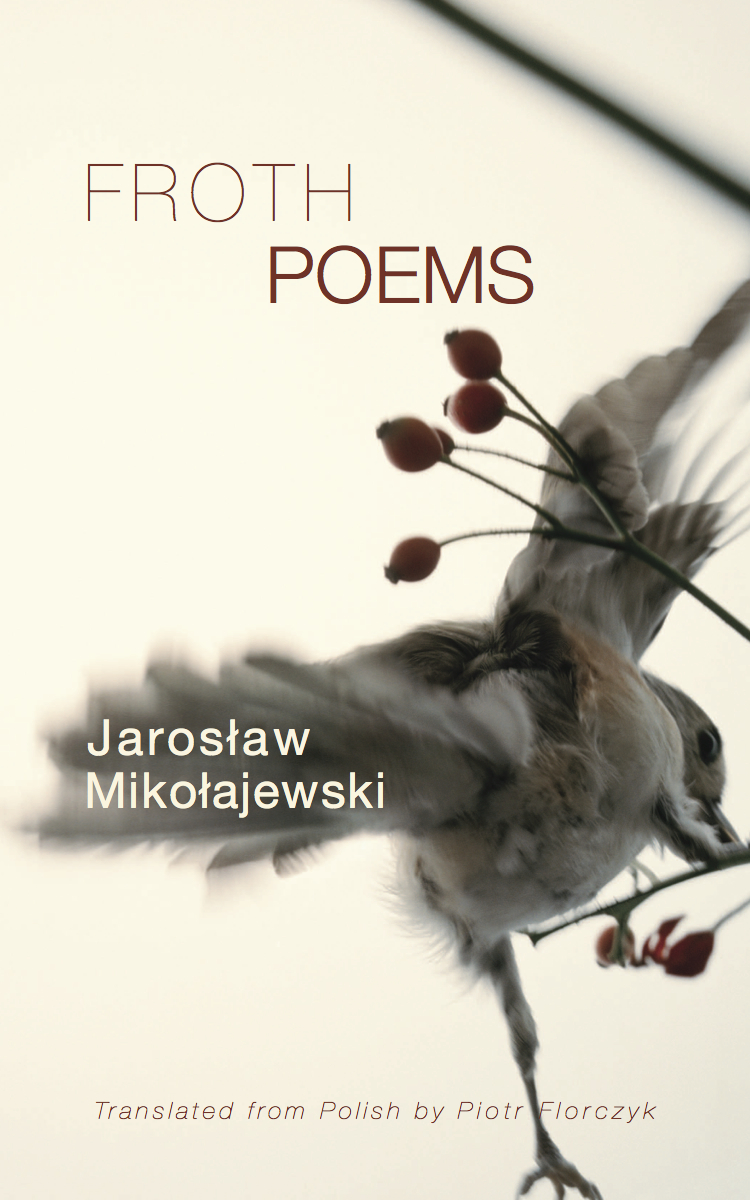
Jarosław Mikołajewski’s Froth: Poems


Piotr Florczyk continues his excellent work bringing Polish poets to an American audience.  His most recent work is a translation of a group of Jarosław Mikołajewski’s best poems.  The collection is called  Froth: Poems (Calypso Editions, 2013), and these poems mix what one critic has called “family theater” with a surrealistic sensitivity that creates a kind of domestic magic that draws you in and makes you want to keep reading and seeing the world through  Mikołajewski’s always engaging and often funny lens.

Mikołajewski, a short story writer, poet and translator, has received tremendous praise.  Ilya Kaminsky calls his poems "contemporary European poetry at its best," and Adam Zagajewski writes, "Mikołajewski's poems are kicking, running, appealing to us, readers. His poems live."

Here are three of the poems from this collection, first in Polish and then in Piotr Florczyk's English.

Kręgosłup mojej żony

W porze oczekiwania
kręgosłup mojej żony jest gałęzią
pękającą od nadmiaru jabłek

pokorną aż do ziemi
z braku odporności

W noce czuwania
jej kręgosłup jest szalikiem
zaciśniętym na wychudłej szyi

W noce miłości zwierzęcej
Jest suwakiem walizki
która nie chce się dopiąć nawet pod kolanem

W noce miłości ludzkiej
jest stalową liną
szeleszczącą na wietrze pod najwyższym napięciem

Na południowym spacerze
kręgosłup mojej żony jest chorągiewką
przewodnika pielgrzymów w przeludnionym kościele

Na wieczór po dniu marszu
jest grupką wylęknionych dzieci
które zepsuły przedszkolne pianino
jest samą klawiaturą
zepsutego pianina

Pod wieczornym prysznicem
jej kręgosłup jest żmiją
w czujnym lenistwie na rozgrzanej drodze

Pod północną kołdrą
kręgosłup mojej żony jest jak drzazga płonąca w piecu
z którego rano wyjmę ciepły chleb


My wife's spine

And when my wife’s pregnant
her spine is a bough
breaking under the weight of apples

humble all the way down to earth
from lack of resistance

On nights of keeping watch
her spine is a scarf
tightened around a slender neck

On nights of animal love
it is the zipper in a suitcase
that won’t close, even under a knee

On nights of human love
it is the steel rope
rustling in the wind, at the highest voltage

On the noon walk
my wife’s spine is the flag
carried by the pilgrims’ guide in a crowded church

In the evening, after a day-long march,
her spine is a bunch of frightened kids
who broke the kindergarten’s piano
it is the keyboard
of the broken piano

When she takes a shower
her spine is a viper
lazing watchfully on a sizzling road

Under the midnight comforter
my wife’s spine is like a wood chip burning in the oven
from which I’ll pull out warm bread at dawn


Między ziemią a nie

ziemia głośno wyje
bo wszedłem na piętro
zejdź bo jestem głodna
skamle drapiąc drzwi

jej łakomy oddech
owiewa mi pięty
żona prosi żebym
uspokoił ją

zatrzaskuję okna
ziemia wyje głośniej
wychodzę na balkon
ona zgina łeb

rzucam jej owoce
woła nakarm sobą
i święcie przyrzeka
to ostatni głód

żeby mi pokazać
jak jest wychudzona
tarza się na grzbiecie
w kurzu swojej krwi

widzę góry żeber
hałdy suchej skóry
waruj wołam z góry
ona woła zejdź

zejdź a będę czuwać
zejdź a będę mruczeć
zejdź a będę ciepła
i miękka jak puch

nie schodź proszą dzieci
kiedy wkładam buty
ziemia warczy
żona
prosi coś z nią zrób


Between earth and not

the earth howls loudly
because I’ve gone upstairs
“come down, I’m hungry”
she yelps, scratching the door

her greedy breath
is fanning my heels
my wife asks me
to calm the earth down

I shut the windows
the earth howls even louder
I walk out onto the balcony
she lowers her gaze

I throw her fruit
she yells “feed me with yourself”
and swears to god
“this is my last hunger”

to show me
how emaciated she is
she rolls around on her back
in the dust of her blood

I see mountains of ribs
heaps of dry skin
“stay put” I call from upstairs
“come down” she says

“come down, I’ll be vigilant”
“come down, I’ll hum for you”
“come down, I’ll be warm
and soft like feathers”

“don’t do it,” the children plead
as I put on my shoes
the earth’s growling
my wife
pleads “do something about her”


unia europejska

za mało biorę do siebie

że wyszedłem w deszcz
miałem wrócić
ale wyszło słońce

pojechałem na cmentarz nieznany
położyłem rękę na grobie
powiedział wstań trupie

wstałem
poszedłem

za mało biorę do siebie
zmiany pogody
przejaśnienia

chciałem pójść w lewo
a siedzę na brudnie z ręką w grobie taty

mój łokieć tęcza nad europą


european union

I don’t take enough personally

that I went out in the rain
had to go back
but the sun came out

I went to visit an unknown cemetery
I put my hand on his grave
he said rise you corpse

I got up
I went

I don’t take enough personally
changes in the weather
clearings-up

I wanted to go to the left
but I’m sitting in the rough with my hand on my father’s
grave

my elbow a rainbow over europe

_______________________

More information about Froth: Poems and other books by Calypso Editions is available by clicking here. 

Writing the Polish Diaspora has also posted on Poitr Florczyk's translations of Anna Swir's Building the Barricades and other Poems and Julian Kornhauser's Been and Gone.  Clicking on these titles will take you to the articles.


Monday, March 18, 2013

What's New? -- Co nowego? Polish Diaspora Writers and Artists Update


If you’re a Polish American writer or editor and do Facebook, I recommend the Polish American Writers and Editors page.  Here’s the link.

Mark Pawlak’s Go to the Pine: Quoddy Journals 2005-2010, a collection of journal poems in the tradition of Basho’s Narrow Road to the Interiors is now available from Plein Air Editions/BootstrapPress.   It’s also available from Amazon.  

Danusha Goska’s personal essay about the meaning of sacrifice appears in The Green Briar Review.

The Polish American Librarians Association is looking for Polish American writers to participate in an American Librarians Association event in Chicago. 

Jannett Matusiak's essay about how she keeps in touch with her family back in Poland papers at her blog.  

Linda Nemec Foster remembers her mother in an essay written for Writing the Polish Diaspora. 

Mark Tardi has a new book of poems out.  It’s called Airport Music, and you can read about it by clicking here.  By the way, there’s more about  Mark and his poems at Writing the Polish Diaspora, click here.

Ewa Thompson, editor of the Sarmatian Review, has published two articles recently which touch on the nature of Polishness: "Reflection on Errors in Western Interpretations of Dostoevsky's The Brothers Karamazov" and "Stefan Zermowski's Ashes as a Postcolonial Narrative."

Bozena Helena Mazur-Nowak is featured with an interview and poems in New Mirage Journal. 

Maja Trochimczyk received a Medal of Merit from the Polish Ministry of Culture for her work with the Madjeska Club of California.  The new issue of Cosmopolitan Review features her article on the Polish Folk Dance movement.  

MacArthur Genius Award Recipient Stuart Dybek spoke before the Polish American Librarians Association at the Polish Museum of America. 

Christina Pacosz has a poem title “Alarm Clock” in Thanal Online. 

Joanna  Ewa Kurowska’s mini-short story "Falsehoods" was just published in Postcard Shorts.  

Mark Lewandowski’s article on “The Parthenon” appears in the most recent issue of Literary Bohemian.  

Adam Lizakowski and Neal Warren have a new chapbook out called Anteroom Poetry.  The book’s available at Amazon.  I’ll be posting a review of this book next week along with a poem or two from it. 

An ebook of Daniela Olszewska's True Confessions of an Escapee from The Capra Facility for Wayward Girls is now available from Spittoon Press.  

Linda Ciulik Wisniewski published a story "You Have to Eat Lunch" about her aunt who passed away recently. 

William Wolak is the featured poet in the British ezine Symmetry Pebbles.  The journal contains an interview with him, three poems, and a recording of him reading a poem.  Click here.  

Piotr Florczyk has a new book of translations out, Froth: Poems by Jarosław Mikołajewski (Calypso Editions, 2013).  Ilya Kaminsky calls the book "contemporary European poetry at its best," while Adam Zagajewski writes, "Mikołajewski's poems are kicking, running, appealing to us, readers.  His poems live." More info available by clicking here.

Some of Grzegorz Wroblewski’s poems and an interview with him appear in a recent issue of the Slovak journal Revue svetovej literatury (World Literature Review).  

Anna Maria Mickiewicz's poem "A London Dream" will is forthcoming in the Poetry Space anthology Through A Child's Eyes: Poems from World War Two.  The book will be launced at the Penzance Festival on July 21st. 

John Guzlowski’s short short story “The Last Dayof Life on Earth” appears in the most recent issue of Atticus Review.  Another one of his short fiction pieces “MyMother’s Funeral” appears in Postcard Shorts.  His poem “At 40 His Wife Begins to Write Poems” is in The Original Van Gogh’s Ear Anthology.   He was also recently interviewed by Rattle.  


Saturday, March 16, 2013

Call for Polish American Writers

The Polish American Librarians Association is looking for writers who live in the Chicago area, or plan to be in Chicago June 29-30, who are willing to participate in PALA's efforts to raise awareness about the Polish diaspora by making an appearance in the PALA exhibit booth during the American Library Association's Annual Conference in Chicago. The conference draws some 25,000 librarians and library supporters from around the country and the world. 

Members of PALA will be hosting the booth and would like to schedule a series of author appearances during exhibit hours to draw visitors to the booth and to stimulate interest in including Polish and Polish American authors in library collections, as well as books that accurately depict the history of Poland and the unique contribution of Poles and people of Polish descent to the world. 

If you are interested, please email Leonard Kniffel, who is coordinating the author appearance for PALA, at lkniffel@sbcglobal.net by March 31.

___________________________

Leonard Kniffel is the author of one of the best books about traveling to Poland, A Polish Son in the Motherland: An American's Journey Home.  

Tuesday, March 12, 2013

Stuart Dybek: A Report by Janusz Zalewski


Janusz Zalewski writes about his recent visit to Chicago and his meeting with Polish-American writer and MacArthur Fellowship recipient Stuart Dybek.  Mr. Dybek delivered the Keynote Address at the meeting of the Polish-American Librarians Association, held at the Polish Museum of America on February 24th.   


________________________________

Stuart Dybek began his keynote address by reading his poem “Penance,” from his first collection Brass Knuckles (1979).  The poem was also published the following year in the anthology of Polish-American poetry Blood of Their Blood, edited by Victor Contoski, in which Dybek was featured among a few dozen other authors.  The poem “Penance” is very characteristic to Dybek’s writing at that time, with his childhood, religion, humor and emotions in it, all on the broader background of ethnicity.

Then, because this was a librarians’ meeting, he talked about his countless visits to Chicago libraries, which were to him both secret and sacred places in his childhood, where he could immerse himself in dreams and “sail with Magellan, Jack London” and others.  Marshall Square Library was the one he said he attended most.

He talked about being a reader and about the act of reading being a form of art.  Readers, Dybek says, are dreamers and artists.  Reading is definitely a more active form of perception than viewing other forms of art, which is closer to plain consumption.  For example, watching a movie or listening to music is essentially engaging senses without actively participating in the process.  Only dancing to music can be compared to reading a book.  In this analogy, reading becomes closer to writing than anyone would imagine, because there is only one step from reading Dostoevsky to grabbing a pen.


For a writer, he continued, readings in a library are very different from readings at universities.  The diversity of people coming to the library makes it so attractive.  All the characters from various populations, ages and ethnic groups form a truly amazing and attentive audience. 

Dybek said that on the East or West Coast he is known as a Chicago writer, but for someone who lives in Chicago it is clear that Chicago writers are categorized as neighborhood writers.  As much as Saul Bellow wrote about Hyde Park, Farrell and Algren wrote about their neighborhoods, Dybek’s writing is immersed in Chicago’s South Side, in particular Pilsen.  One of the reasons he keeps writing about his neighborhood is that it is inescapable.  Assimilation, race, ethnicity (which is a currency of Chicago writing), dreams of democracy, promise of America, all this makes a microcosm, in which it’s easier for a writer to meet his readers.  Ethnicity especially is an enormous gift to a writer, says Dybek. 

Then, Dybek addressed his heritage and talked about his Busia (grandma), how much she affected him, and he refered to a story “Blood Soup” as a tribute to her.  Finally, interacting with the audience, he recalled his multiple other stories, among them one about his Dziadzia (grandpa), who along with a mule was the only one to survivor a disaster in a coal mine.  He was a tough character.

After the presentation, Stuart and I wandered around the old Polish neighborhood that’s the home for the Polish Museum of America.  On a way for dinner we stopped at the Chopin Theatre, at the corner of Division and Milwaukee, an amazing place led by an even more amazing man, Zygmunt Dyrkacz.  Next door, sitting at the bar in “Podhalanka,” we recall when Dziadzia used to bring young Stuart (they called him Stuluś), placed him on a bar and ordered to sing for the audience.  The evening gets closer and it’s time to go home.

Dybek's most recent book of stories is I Sailed with Magellan.   Two new collections by Dybek are due this year from Farrar, Straus and Giroux.  One piece of a short fiction titled “Trust Cuts Both Ways” that made it into the first book, Paper Lantern, is included below.  It was originally printed in a short-lived magazine named Joe, published by Starbucks, in 1999.


________________________________

Penance

It was always Good Friday
those Saturday afternoons.
Stooped babkas in black coats
and babushkas, kneeling
in marble aisles
before racks of vigil candles,
faces buried in hands.
Weeping echoes through the dim church
as foreign as their droned
language of prayer.
I stood in line
waiting the priest’s question,
“Alone or with others?”
and my turn in Confession
trying to imagine
the terrible sins of old women.


Trust Cuts Both Ways

- “Do you fantasize about me?” - she asked.

- “Sure” – he said, not volunteering any more information.

- “I have the oddest fantasies about what I’d like to do with you.” – she said.

- “Like what, for instance?”’

- “I want to shave you.”

- “I want to shave you too.” – he said.

- “Not that way” – she said. – “I mean it. I picture you soaking in a steamy tub, a beautiful
old claw footer, and I lather your beard with a boar-bristle brush.  I even know where they
sell them – at Crabtree & Evelyn.  Then, you lie back and close your eyes, and with an old-
fashioned straight razor that makes the sexiest scraping sound, I give you the best, closest
shave you’ll ever have. Shave you clean and smooth and rinse your skin as if I’m your geisha.”

- “Sounds nice – he said, rather than tell her there was no way in hell she was getting near him with a razor.”


Stuart Dybek


________________________________ 

Janusz Zalewskis has translated a number of works by Stuart Dybek into Polish:
:
- „Nie udało nam się“ (We Didn’t), in Odra, No. 12/2004

- „Pan Placki” (The Palatski Man), in Arcana, No. 57/2004

- „Czarny Anioł” (Black Angel) and „Wietrzne miasto” (Windy City), in Nowa Okolica Poetów, No. 18-19/2005.

An extensive biographical note and links to some of Stuart Dybek's other writings are available at the Poetry Foundation.  Click here.  

Thursday, March 7, 2013

Helen Kumor Nemec -- A Remembrance


Poet Linda Nemec Foster honors us with this memory of her mother and a poem:


My mother, Helen Kumor Nemec, died on July 8 of 2012 (aged 92).  Soon after her death, I shared the poem, "Contour of Absence," and a photo from my mother's obituary notice with my good friend, John Guzlowski.  At the time, John asked if he could post the poem and photo on his blog, but he also wanted me to send him some words about her life that he could include to give the poem and photo context.  It's taken me a while--over seven months--to finally honor his request.  I think the reason for the time-lapse has to do with grief and how we process it.  My father died in 2009 (aged 88) and, because I always felt closer to my Dad, the grief I went through at the time seemed to be "the good grief" that happens when relationships are resolved and there is a sense of closure.  

That's how it was for my Dad but with my mother it was different.  We never had a close relationship, although I always wanted one. She had a hard time relating to her children (I have a younger sister) and her marriage to my father was not very happy (even though they were married for 60 years).  For years, I felt frustration and bitterness until I remembered a tragedy that occurred in her family.  

In 1918, the year before my mother was born, her parents lost two daughters: an 18-month-old girl who died of the influenza epidemic that struck the world after WWI; and a 7-year-old who died after a tragic playground accident (she fell off a slide and suffered a massive head injury).  Whenever I would ask my mother how she felt about the deaths of these two sisters she would say, "They died before I was born, so I never cried for them.  How could you miss someone in your life when you never knew them?  Their deaths never affected me."  But she was so wrong.  Her parents died early because of their guilt and grief.  My maternal grandfather, Tomasz Kumor, died of a heart attack at 42 when my mother was 10 years old.  His wife, Marianna, was left to raise four children.  She died five years later (aged 49) of blood poisoning caused by an acute bacterial infection.  My mother was 15.  Her parents (and my father's parents) came from southern Poland in the early 20th century to find a better life in America.  Imagine the shock of the family in Poland when they heard the sad news of the deaths of the two daughters and, later, the deaths of the parents.

My mother rarely spoke of these tragedies but I know they affected her life in many ways.  I'm certain those hard years of loss and abandonment affected her emotional and psychological development.  And, because of this certainty, I have finally been able to see my mother in a totally different light:  not colored by anger, frustration, and bitterness but by compassion and forgiveness.

And she did give me a very important gift.  Helen Kumor Nemec was the one that kept close contact with our family in Poland and urged me to do the same.  When she died, my relatives in Poland were saddened by her passing--they remembered all her letters and cards, gifts and parcels.  She never forgot them.  In some way, perhaps her relationship to her family in Poland was easier to nurture than the challenging relationships to her husband and children.  

In the last seven years of her life, my mother suffered from dementia.  But instead of a curse, it was a blessing.  She became mellow, easier to talk to.  She laughed a lot and would say some amazingly wise things about life and everything in it.  Even though she was an emotionally distant mother for the first 55 years of my life, I'm grateful for those last seven years.  I'm grateful for that last visit when she laughed and showed me her newly polished nails...as if I was the mother and she was the little girl.


_____________________________

Contour of Absence

(after the painting "Provincetown in Winter, 1918"
by Gerrit Beneker)

Is this what the new world has given us?
A place of broken ice, its center of negative
space devoid of real color except for the dream-
like mauve, teal, and red of boats locked
and listing in their quiet sleep of winter.

Half-way into the continent, in a place of factories
not boats, my mother is being conceived
by her immigrant parents.  Not for love
or passion or longing but to erase the contour
of absence:  the silhouette of two daughters
who died the previous year.  By illness
or accident, it makes no difference.  The death
of a child releases one soul and enslaves
all others.  The mother forgets to brush
her hair for weeks.  The father can barely
remember how to walk down his street.

But how can my mother know this,
starting the thin journey to her life?
And how can the winter with all its snow and ice
mask true sorrow when everything
in this frozen universe hopes for spring?
The two boats leaning into each other
as if in unmarked graves.  The sky,
gray and calm, waiting to be born.


_____________________________

This poem was previously published in Linda's book, Talking Diamonds (New Issues Press, 2009).